Hearing Loss Evaluation in Raipur

Pure Tone Audiometry test measuring different types of hearing loss in Raipur
Uncategorized

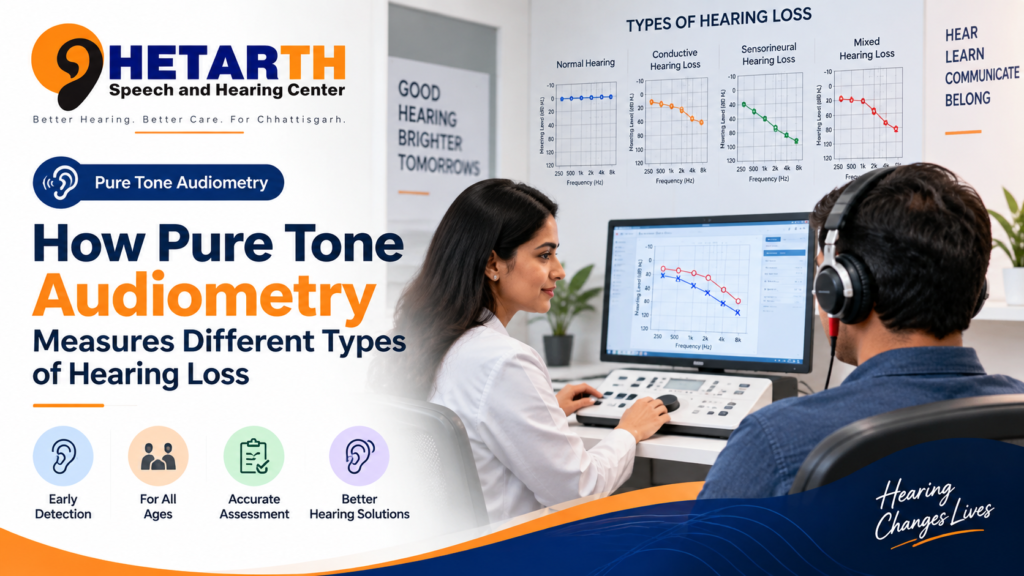
How Pure Tone Audiometry Measures Different Types of Hearing Loss

Hearing helps us communicate, learn, work, and stay connected with the people around us. When hearing becomes difficult, it can affect conversations, education, professional life, and everyday activities. One of the most commonly used tests for evaluating hearing ability is Pure Tone Audiometry in Raipur. Pure Tone Audiometry is a detailed hearing test that measures the softest sounds a person can hear at different frequencies. It helps an audiologist understand whether hearing is within the expected range or whether hearing loss is present. The test can also help determine the degree and pattern of hearing loss. At Hetarth Speech And Hearing Center, Pure Tone Audiometry is used as part of professional hearing assessment for children, adults, and senior citizens. Our qualified audiology team focuses on understanding each person’s hearing concerns and selecting appropriate assessment methods according to their age, symptoms, and communication needs. But how does Pure Tone Audiometry actually measure hearing loss? Can it identify different types of hearing loss? And what do the results mean? Let’s understand the process step by step. What Is Pure Tone Audiometry? Pure Tone Audiometry is a behavioral hearing test used to determine the quietest sounds a person can hear at different frequencies. During the assessment, an audiologist presents pure tones through headphones, insert earphones, or a bone-conduction device. The person responds whenever they hear a sound, even if it is very soft. The results are plotted on a graph called an audiogram. The audiogram allows the audiologist to compare hearing sensitivity across different frequencies and identify patterns that may indicate hearing loss. A typical Pure Tone Audiometry Test in Raipur may assess frequencies important for understanding speech as well as other frequencies that provide information about overall hearing sensitivity. At Hetarth Speech And Hearing Center, the test is performed in a controlled environment, and the audiologist explains the procedure before beginning the assessment. Why Is Pure Tone Audiometry Important for Hearing Loss? Hearing loss is not always the same for every person. Someone may have difficulty hearing low-frequency sounds, while another person may have greater difficulty hearing high-frequency sounds. Similarly, hearing loss may affect one ear or both ears. Pure Tone Audiometry in Raipur helps provide objective information about these differences by measuring hearing thresholds at multiple frequencies. The results can help an audiologist determine: Whether hearing loss is present Which ear is affected The degree of hearing loss Which frequencies are affected Whether hearing loss appears conductive, sensorineural, or mixed Whether further hearing tests may be useful Whether hearing-aid evaluation may be appropriate This makes Pure Tone Audiometry an important part of a comprehensive audiological evaluation. How Does Pure Tone Audiometry Measure Hearing? The basic principle behind Pure Tone Audiometry is simple. The audiologist presents sounds at different frequencies and gradually changes their intensity. The patient responds when they hear the sound. The quietest level at which a person can consistently detect a particular tone is called the hearing threshold. Thresholds are measured across different frequencies, commonly including 250 Hz, 500 Hz, 1000 Hz, 2000 Hz, 4000 Hz, and 8000 Hz, depending on the assessment requirements. The results are then plotted on an audiogram. The audiogram gives the audiologist a visual representation of the person’s hearing sensitivity. What Happens During Pure Tone Audiometry in Raipur? If you are visiting Hetarth Speech And Hearing Center for Pure Tone Audiometry in Raipur, the audiologist will generally begin by discussing your hearing concerns and relevant history. The process may include the following steps. 1. Discussion About Your Hearing The audiologist may ask questions about: Your hearing difficulties When the problem started Whether one or both ears are affected Difficulty understanding speech Noise exposure Ear infections or ear-related problems Ringing or buzzing sounds Previous hearing tests Hearing-aid use This information helps the audiologist understand your concerns before testing begins. 2. Preparing for the Test You will usually be seated in a quiet testing environment or sound-treated room. Headphones or insert earphones may be placed over or inside the ears. The audiologist explains how you should respond whenever you hear a tone. 3. Presenting Pure Tones The audiologist presents sounds at different frequencies and intensities. Some tones may be easy to hear, while others may be extremely soft. You may be asked to press a button, raise your hand, or provide another response whenever you hear a sound. 4. Finding Hearing Thresholds The audiologist gradually adjusts the loudness of each tone to determine the softest level that you can reliably hear. These results become your hearing thresholds. 5. Creating the Audiogram The thresholds are plotted on an audiogram. The audiogram provides valuable information about the pattern and degree of hearing loss. How Does Pure Tone Audiometry Identify Conductive Hearing Loss? Conductive hearing loss occurs when sound has difficulty travelling through the outer or middle ear. Possible causes can include: Earwax blockage Middle-ear fluid Ear infections Eardrum problems Problems involving the middle-ear bones During Pure Tone Audiometry in Raipur, both air-conduction and, when required, bone-conduction thresholds may be measured. Air conduction evaluates hearing through the complete hearing pathway, while bone conduction helps assess the inner ear more directly by bypassing parts of the outer and middle ear. If there is a noticeable difference between air-conduction and bone-conduction thresholds, called an air-bone gap, it may suggest a conductive component. The audiologist may recommend additional tests or medical evaluation depending on the findings. At Hetarth Speech And Hearing Center, the test results are interpreted in combination with the patient’s history and other relevant findings rather than looking at the audiogram alone. How Does Pure Tone Audiometry Identify Sensorineural Hearing Loss? Sensorineural hearing loss involves the inner ear or the auditory nerve pathways. Common factors associated with sensorineural hearing loss include: Age-related hearing changes Long-term noise exposure Certain genetic conditions Some illnesses or medical conditions Certain medications Inner-ear disorders In sensorineural hearing loss, air- and bone-conduction thresholds are generally reduced without a significant air-bone gap. The pattern may be mild in some frequencies and more severe in others. For example, a person may have relatively better hearing at lower frequencies but significantly poorer hearing at higher frequencies. This type of pattern is often seen in
Pure Tone Audiometry test measuring different types of hearing loss in Raipur
Uncategorized

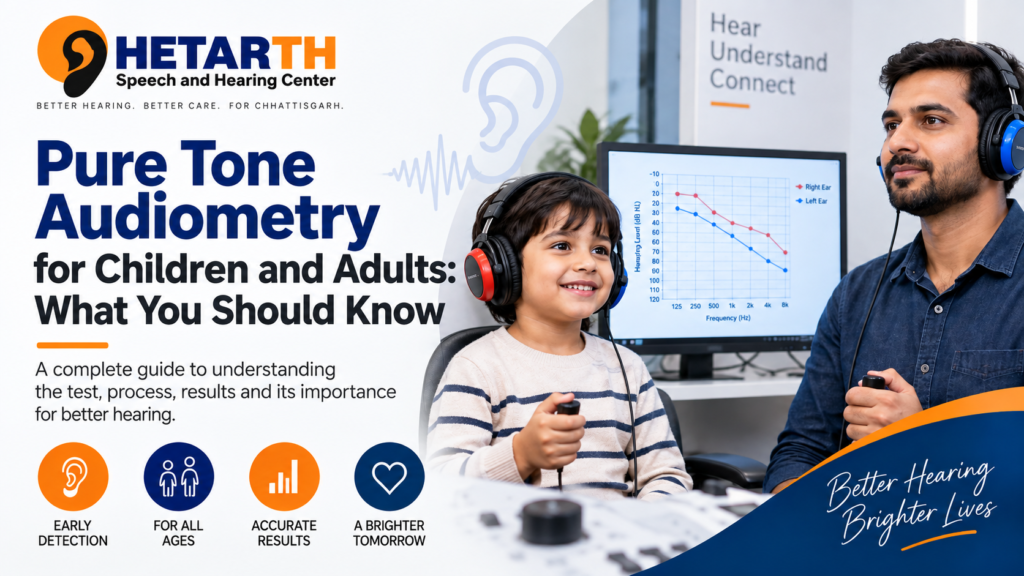
Pure Tone Audiometry for Children and Adults: What You Should Know

Hearing allows us to communicate, learn, work, and stay connected with the people around us. When hearing becomes difficult, even simple conversations can become challenging. A hearing assessment can help identify whether a person has hearing loss, how much hearing has changed, and what type of hearing care may be appropriate. One of the most commonly used hearing tests for evaluating hearing sensitivity is Pure Tone Audiometry in Raipur. This test helps an audiologist understand the softest sounds a person can hear at different pitches. Pure tone audiometry can be useful for both children and adults. However, the way the test is performed may vary depending on the person’s age, ability to respond, attention span, and communication skills. At Hetarth Speech And Hearing Center, pure tone audiometry is performed as part of professional hearing assessment based on the individual’s requirements. The goal is not simply to conduct a test but to understand the person’s hearing ability and explain the findings clearly. This guide explains what pure tone audiometry is, who may need it, how the test works for children and adults, what the results mean, and what you can expect during your visit. What Is Pure Tone Audiometry in Raipur? Pure Tone Audiometry in Raipur is a hearing assessment used to determine the softest level of pure-tone sounds that a person can hear at different frequencies. During the assessment, an audiologist presents sounds through headphones or other appropriate equipment. The person is asked to respond whenever they hear a sound, even when the sound is very soft. The responses are recorded and used to create an audiogram. The audiogram provides information about hearing sensitivity across different frequencies. At Hetarth Speech And Hearing Center, the audiologist considers the test findings along with the person’s hearing history, symptoms, age, communication needs, and other relevant information. Pure tone audiometry can help identify hearing differences between the right and left ears and can provide useful information when evaluating suspected hearing loss. Why Is a Pure Tone Audiometry Test in Raipur Performed? A Pure Tone Audiometry Test in Raipur may be recommended when a person has difficulty hearing conversations, frequently asks others to repeat themselves, turns up the television volume, or experiences other signs of hearing difficulty. The test may also be recommended for children when there are concerns about hearing, speech and language development, classroom performance, or responses to sound. Common reasons for conducting a Pure Tone Audiometry Test in Raipur include: Suspected hearing loss Difficulty understanding speech Age-related hearing changes Noise exposure Concerns about a child’s hearing Delayed speech or language development Difficulty hearing in classrooms Tinnitus or ringing in the ears Monitoring hearing over time Hearing-aid assessment Baseline hearing evaluation A pure tone test is one part of a complete audiological assessment. Depending on the individual’s symptoms and history, the audiologist may recommend additional tests. How Does Pure Tone Audiometry Work? During Pure Tone Audiometry in Raipur, the audiologist presents tones at different frequencies and intensities. The test generally examines hearing across a range of frequencies important for understanding speech and other everyday sounds. A person may hear some tones easily while other tones may need to be louder before they can be detected. The audiologist records these responses and plots them on an audiogram. The assessment is generally non-invasive and does not require needles or surgery. The patient simply needs to listen carefully and respond whenever a sound is heard. At Hetarth Speech And Hearing Center, the audiologist explains the procedure before beginning the assessment so patients know what to expect. What Happens During Pure Tone Audiometry for Children in Raipur? Pure Tone Audiometry for Children in Raipur may be slightly different from testing an adult because children have different attention spans, communication abilities, and levels of understanding. Before beginning the test, the audiologist may explain the procedure in a simple and child-friendly manner. Depending on the child’s age and developmental level, the response method can be adapted. For example, a child may be asked to: Raise a hand when a sound is heard Press a button Place a toy in a container after hearing a sound Perform another simple response activity The exact approach depends on the child’s age and ability to participate reliably. At Hetarth Speech And Hearing Center, Pure Tone Audiometry for Children in Raipur is approached with patience and age-appropriate communication. Creating a comfortable environment can help children understand the activity and respond more naturally. Parents may be asked about the child’s hearing history, speech and language development, ear infections, school performance, or other relevant concerns. Why Is Pure Tone Audiometry for Children in Raipur Important? Hearing plays an important role in a child’s speech, language, learning, and social development. A child may not always be able to tell parents that sounds are difficult to hear. Some children may compensate for hearing difficulty by watching faces, sitting closer to teachers, or relying on visual cues. Pure Tone Audiometry for Children in Raipur can provide useful information about hearing sensitivity when a child is able to participate in the test appropriately. Parents may consider a hearing assessment if a child: Does not consistently respond when called Frequently asks for repetition Has delayed speech development Has difficulty following verbal instructions Struggles to hear in a classroom Appears to hear some sounds but misses others Has a history of frequent ear infections Turns the television volume very high Has difficulty understanding conversations Early identification of hearing concerns can help families understand whether hearing may be contributing to communication or learning difficulties. What Happens During Pure Tone Audiometry for Adults in Raipur? Pure Tone Audiometry for Adults in Raipur generally involves listening to tones through headphones or another appropriate transducer. The audiologist presents sounds at different frequencies and gradually adjusts their intensity. The individual responds whenever a sound is heard. The objective is to determine the softest level at which the person can detect different tones. The test may involve separate assessment of each ear. Depending on the clinical requirement, additional testing may also be performed. At Hetarth Speech And Hearing Center, Pure Tone Audiometry for

Comprehensive hearing loss evaluation and hearing assessment for children and adults in Raipur
Uncategorized

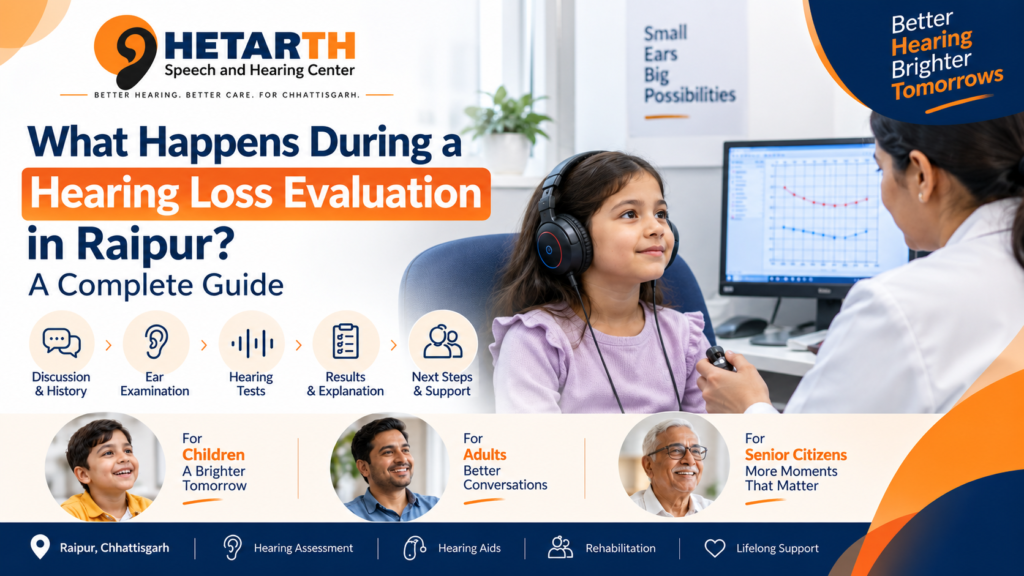
What Happens During a Hearing Loss Evaluation? A Complete Guide

Hearing can change slowly, and many people do not notice the change until everyday conversations become difficult. You may find yourself asking others to repeat sentences, increasing the television volume, struggling to understand speech in crowded places, or missing parts of phone conversations. Children may show different signs, such as not responding consistently to their name, delayed speech development, or difficulty following spoken instructions. A professional hearing assessment can help identify whether hearing has changed, how much it has changed, and what type of support may be appropriate. This is where a structured Hearing Loss Evaluation in Raipur can make the process clearer for individuals and families. At Hetarth Speech And Hearing Center, the evaluation process is designed around the person’s age, symptoms, communication needs, and hearing history. The goal is not simply to perform a test. It is to understand the hearing concern, explain the results, and discuss practical next steps in a comfortable and patient-friendly setting. Our Audiologist in Raipur takes time to understand each person’s concerns and explain the assessment process before discussing the next step. Why Is a Hearing Loss Evaluation in Raipur Important? Hearing loss can have different causes, patterns, and levels of severity. Two people with similar complaints may have very different hearing profiles. A professional evaluation gives objective information that can support appropriate management. A Hearing Evaluation in Raipur may be recommended when someone notices reduced hearing, difficulty understanding speech, ringing in the ears, frequent requests for repetition, or changes in communication. It can also be useful when a doctor, teacher, parent, or family member has noticed possible hearing difficulties. At Hetarth Speech And Hearing Center, the process begins with listening to the person’s concerns. This helps the audiologist choose suitable assessment procedures instead of using exactly the same test for everyone. For children, the approach may need to be age-appropriate and engaging. For adults and older people, testing may focus on real-world communication problems, hearing ability, and the possible benefit of hearing solutions. Who May Need a Hearing Evaluation in Raipur? A hearing check may be useful for people of different ages. Adults may seek an assessment because conversations have become harder to follow, while parents may notice signs of hearing or speech concerns in a child. Senior citizens may experience gradual age-related changes and assume they are simply part of getting older. A Hearing Assessment in Raipur may be considered for: People who often ask others to repeat themselves Anyone who feels that people are mumbling Individuals who struggle to hear in restaurants, meetings, or group conversations People who turn up television or mobile volume Individuals exposed to loud occupational or recreational noise People who notice ringing or buzzing in the ears Children with delayed or unclear speech Children who do not consistently respond to sounds Older adults with increasing communication difficulty Anyone who wants a baseline check of hearing At Hetarth Speech And Hearing Center, the audiologist can explain which assessment is appropriate for the individual’s age and symptoms. What Happens Before the Hearing Test in Raipur? The evaluation usually starts with a detailed discussion rather than immediately placing headphones on the patient. This first conversation helps build a picture of the hearing concern. During a Hearing Test in Raipur, the audiologist may ask about when the hearing difficulty began, whether one or both ears are affected, previous ear infections, noise exposure, medical history, family history of hearing problems, and communication challenges. For a child, parents or caregivers may provide most of the history. For older adults, family members can also describe situations in which communication has become difficult. This initial discussion is important because hearing test results need to be understood together with the person’s history and everyday experience. At Hetarth Speech And Hearing Center, patients and families are encouraged to ask questions before testing begins. Knowing what will happen can make the experience more comfortable and less stressful. How Is an Audiological Evaluation in Raipur Performed? An Audiological Evaluation in Raipur may involve one or several tests, depending on the person’s age, symptoms, and clinical requirements. The audiologist selects procedures that provide useful information about hearing sensitivity and how a person responds to different sounds. Common components may include: 1. Otoscopic Examination The audiologist may visually inspect the ear canal and eardrum using an otoscope. This can help identify visible concerns such as wax buildup, irritation, or other issues that may affect testing. 2. Pure-Tone Audiometry Pure-tone testing measures the softest sounds a person can hear at different pitches. The patient usually wears headphones or insert earphones and responds when a tone is heard. The goal is to identify hearing thresholds for each ear. These results are often shown on an audiogram. 3. Speech Audiometry Speech testing looks at how well a person hears and understands spoken words. It can provide information that complements pure-tone testing. The person may be asked to repeat words or identify speech presented at different levels. 4. Tympanometry Tympanometry measures how the middle ear system responds to changes in air pressure. It can provide useful information about middle-ear function. 5. OAE Testing Otoacoustic emissions, or OAE testing, can be used to assess cochlear function and is particularly useful in certain pediatric and screening situations. 6. ABR or BERA Auditory Brainstem Response testing, commonly called ABR or BERA, records responses from the auditory pathway to sound. It may be considered when behavioral testing is difficult or when more detailed assessment is required. Not every person needs every test. The selection depends on the clinical question. Is a Hearing Loss Evaluation in Raipur Painful? In most cases, standard hearing assessment procedures are non-invasive and do not cause pain. Some tests involve listening to tones or speech through headphones or insert earphones. Tympanometry uses changes in air pressure in the ear canal, which may feel unusual for a few seconds but is generally brief. If you are nervous about testing, tell your audiologist. The professional can explain each step before it starts. At Hetarth Speech And Hearing Center, the team focuses on explaining the process

Scroll to Top

Book A Free Consultation!