
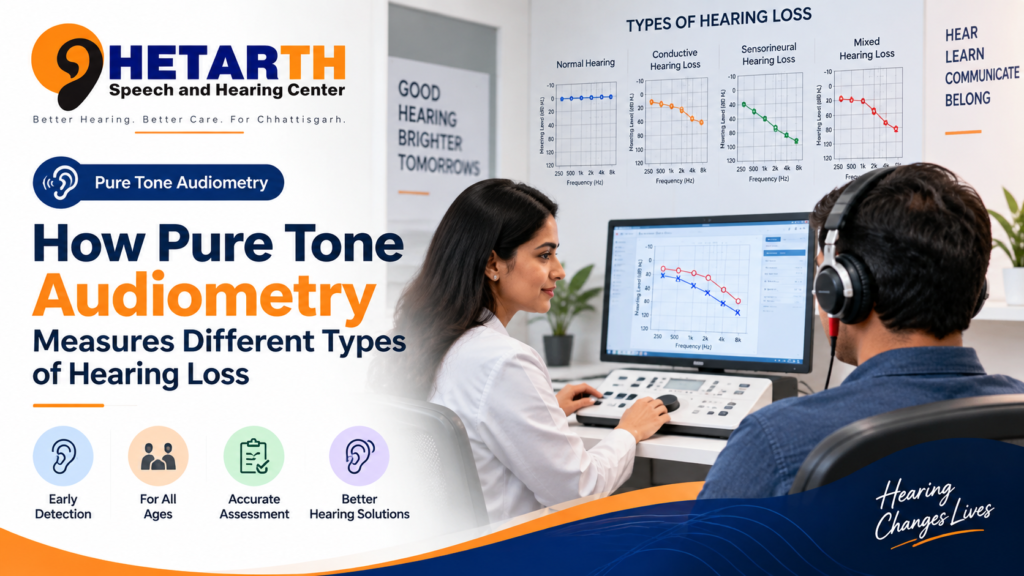
How Pure Tone Audiometry Measures Different Types of Hearing Loss
Hearing helps us communicate, learn, work, and stay connected with the people around us. When hearing becomes difficult, it can affect conversations, education, professional life, and everyday activities. One of the most commonly used tests for evaluating hearing ability is Pure Tone Audiometry in Raipur. Pure Tone Audiometry is a detailed hearing test that measures the softest sounds a person can hear at different frequencies. It helps an audiologist understand whether hearing is within the expected range or whether hearing loss is present. The test can also help determine the degree and pattern of hearing loss. At Hetarth Speech And Hearing Center, Pure Tone Audiometry is used as part of professional hearing assessment for children, adults, and senior citizens. Our qualified audiology team focuses on understanding each person’s hearing concerns and selecting appropriate assessment methods according to their age, symptoms, and communication needs. But how does Pure Tone Audiometry actually measure hearing loss? Can it identify different types of hearing loss? And what do the results mean? Let’s understand the process step by step. What Is Pure Tone Audiometry? Pure Tone Audiometry is a behavioral hearing test used to determine the quietest sounds a person can hear at different frequencies. During the assessment, an audiologist presents pure tones through headphones, insert earphones, or a bone-conduction device. The person responds whenever they hear a sound, even if it is very soft. The results are plotted on a graph called an audiogram. The audiogram allows the audiologist to compare hearing sensitivity across different frequencies and identify patterns that may indicate hearing loss. A typical Pure Tone Audiometry Test in Raipur may assess frequencies important for understanding speech as well as other frequencies that provide information about overall hearing sensitivity. At Hetarth Speech And Hearing Center, the test is performed in a controlled environment, and the audiologist explains the procedure before beginning the assessment. Why Is Pure Tone Audiometry Important for Hearing Loss? Hearing loss is not always the same for every person. Someone may have difficulty hearing low-frequency sounds, while another person may have greater difficulty hearing high-frequency sounds. Similarly, hearing loss may affect one ear or both ears. Pure Tone Audiometry in Raipur helps provide objective information about these differences by measuring hearing thresholds at multiple frequencies. The results can help an audiologist determine: Whether hearing loss is present Which ear is affected The degree of hearing loss Which frequencies are affected Whether hearing loss appears conductive, sensorineural, or mixed Whether further hearing tests may be useful Whether hearing-aid evaluation may be appropriate This makes Pure Tone Audiometry an important part of a comprehensive audiological evaluation. How Does Pure Tone Audiometry Measure Hearing? The basic principle behind Pure Tone Audiometry is simple. The audiologist presents sounds at different frequencies and gradually changes their intensity. The patient responds when they hear the sound. The quietest level at which a person can consistently detect a particular tone is called the hearing threshold. Thresholds are measured across different frequencies, commonly including 250 Hz, 500 Hz, 1000 Hz, 2000 Hz, 4000 Hz, and 8000 Hz, depending on the assessment requirements. The results are then plotted on an audiogram. The audiogram gives the audiologist a visual representation of the person’s hearing sensitivity. What Happens During Pure Tone Audiometry in Raipur? If you are visiting Hetarth Speech And Hearing Center for Pure Tone Audiometry in Raipur, the audiologist will generally begin by discussing your hearing concerns and relevant history. The process may include the following steps. 1. Discussion About Your Hearing The audiologist may ask questions about: Your hearing difficulties When the problem started Whether one or both ears are affected Difficulty understanding speech Noise exposure Ear infections or ear-related problems Ringing or buzzing sounds Previous hearing tests Hearing-aid use This information helps the audiologist understand your concerns before testing begins. 2. Preparing for the Test You will usually be seated in a quiet testing environment or sound-treated room. Headphones or insert earphones may be placed over or inside the ears. The audiologist explains how you should respond whenever you hear a tone. 3. Presenting Pure Tones The audiologist presents sounds at different frequencies and intensities. Some tones may be easy to hear, while others may be extremely soft. You may be asked to press a button, raise your hand, or provide another response whenever you hear a sound. 4. Finding Hearing Thresholds The audiologist gradually adjusts the loudness of each tone to determine the softest level that you can reliably hear. These results become your hearing thresholds. 5. Creating the Audiogram The thresholds are plotted on an audiogram. The audiogram provides valuable information about the pattern and degree of hearing loss. How Does Pure Tone Audiometry Identify Conductive Hearing Loss? Conductive hearing loss occurs when sound has difficulty travelling through the outer or middle ear. Possible causes can include: Earwax blockage Middle-ear fluid Ear infections Eardrum problems Problems involving the middle-ear bones During Pure Tone Audiometry in Raipur, both air-conduction and, when required, bone-conduction thresholds may be measured. Air conduction evaluates hearing through the complete hearing pathway, while bone conduction helps assess the inner ear more directly by bypassing parts of the outer and middle ear. If there is a noticeable difference between air-conduction and bone-conduction thresholds, called an air-bone gap, it may suggest a conductive component. The audiologist may recommend additional tests or medical evaluation depending on the findings. At Hetarth Speech And Hearing Center, the test results are interpreted in combination with the patient’s history and other relevant findings rather than looking at the audiogram alone. How Does Pure Tone Audiometry Identify Sensorineural Hearing Loss? Sensorineural hearing loss involves the inner ear or the auditory nerve pathways. Common factors associated with sensorineural hearing loss include: Age-related hearing changes Long-term noise exposure Certain genetic conditions Some illnesses or medical conditions Certain medications Inner-ear disorders In sensorineural hearing loss, air- and bone-conduction thresholds are generally reduced without a significant air-bone gap. The pattern may be mild in some frequencies and more severe in others. For example, a person may have relatively better hearing at lower frequencies but significantly poorer hearing at higher frequencies. This type of pattern is often seen in